Jokulsarlon Northern Lights
Season, conditions, forecasts and photography notes for aurora nights at the lagoon
The aurora season in Iceland runs from late August until late April. Seeing the lights takes darkness and clear skies, or at least gaps in the cloud cover, preferably towards the north. Jökulsárlón's remote position at the edge of Vatnajökull National Park means little light pollution, which makes it one of the darker places in Iceland for aurora viewing.
- Late August to late AprilAurora season in Iceland
- September and March equinoxesActivity said to peak around
- Around midnightUsually strongest
- About 1 to 3 daysSolar wind travel time to Earth
The aurora season
Northern Lights activity in Iceland is said to peak around the September and March equinoxes. Chances also improve in midwinter, when the nights are longer.
| Timing | Stated detail |
|---|---|
| Season in Iceland | Late August until late April |
| Earliest sightings | As early as August, once the night skies get dark enough and the weather is favourable |
| Start of the main season | October |
| Activity peak in Iceland | Around the September and March equinoxes |
| Peak near Jokulsarlon | November to February, within a season running late September to early April |
Late summer and early autumn
The lights can be seen in Iceland as early as August, once night skies are dark enough and the weather is favourable. The northern lights have been photographed over Jokulsarlon lagoon in September. October marks the start of the main Northern Lights season in Iceland.
Midwinter
Peak aurora viewing near Jokulsarlon is given as November to February, within a season running late September to early April.
Conditions that decide a good night
Seeing the aurora requires darkness and clear skies, or at least gaps in the cloud cover, preferably towards the north. The lights are most visible on clear nights, away from the light pollution of populated areas.
Moonlight
Moonlight somewhat reduces aurora visibility, but it can help by outlining the landscape below.
Cloud on the South Coast
The South Coast tends to be wetter and windier than northern Iceland and the Eastfjords, owing to exposure to Atlantic storms.
What time of night the lights appear
Aurora activity in Iceland is usually strongest around midnight and for a few hours either side of it.
Forecasts and cloud cover
Solar wind particles take about 1 to 3 days to reach Earth, so major geomagnetic storms can be predicted days ahead. Reliable aurora forecasts are possible about one hour ahead.
Vedur.is and aurora forecast apps can be used to track aurora activity and cloud cover. The IMO cloud cover forecast is a map in which white areas mean clear skies, so visitors can check where skies are likely to be clear.
The Bz value
When the Bz value is negative (south), aurora is active. When it is positive (north), aurora is weak or off.
What the aurora looks like
Auroras can appear as spots, arcs, billowing curtains or coronae that seem to radiate from a point in the sky.
Colours and altitude
- The most common aurora colours, green and yellow-green, occur at roughly 90 to 200 km altitude, where solar particles hit oxygen atoms.
- Red, blue and purple aurora colours come from the stimulation of nitrogen.
- Rare red aurora is produced by collisions with oxygen at higher altitudes, up to about 200 miles above the Earth's surface.
The lagoon as an aurora setting
Jökulsárlón is accessible year-round from Road 1, and there is a café by the lagoon. Its remote position at the edge of Vatnajökull National Park means little light pollution.
The lagoon itself
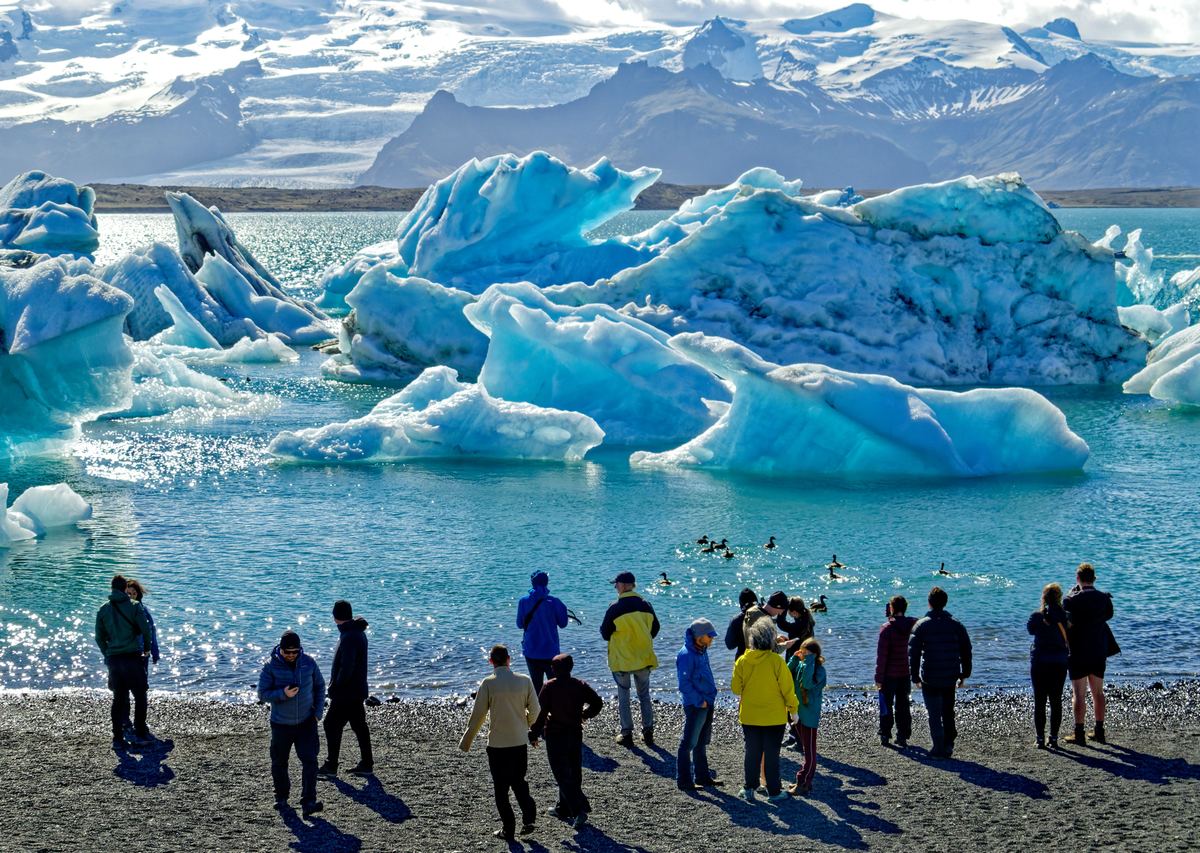
The lagoon covers a surface area of about 25 square kilometres. A 2009 report put it at over 284 metres deep at its deepest, making it the deepest lake in Iceland. It started to form in the 1930s, after Breiðamerkurjökull began receding in the late 19th century.
Diamond Beach and Fjallsarlon
Diamond Beach lies just across the road from Jokulsarlon, and its scattered ice chunks on black sand can be photographed under moonlight and aurora. Fjallsarlon Glacier Lagoon, a quieter neighbour of Jokulsarlon, is also suggested for aurora reflection photos.
Photographing the aurora
The most important equipment for aurora photography is a tripod and a cable release, to avoid shaken photos. A DSLR or mirrorless camera with manual control and a wide-angle lens is suggested.
| Setting | Suggested value |
|---|---|
| ISO | 800–3200 |
| Aperture | f/2.8–f/5.6 |
| Shutter speed | 10 to 30 seconds with a wide aperture |
| Exposure time | 5 to 30 seconds at f/2.8–f/4 |
Dressing for aurora viewing in the cold
Recommended clothing for aurora viewing in the cold is multiple thermal layers, gloves, a windproof jacket and warm boots.
Staying several nights
Aurora is unpredictable far in advance, and a longer stay in Iceland raises the chance of seeing it. Hali, Hof and Skaftafell are named as nearby places to stay overnight, allowing aurora viewing over several nights.
Tours
Tours in the Jokulsarlon area
Jokulsarlon northern lights: common questions
When is the aurora season in Iceland?
The aurora season in Iceland runs from late August until late April. The lights can be seen as early as August once the night skies get dark enough and the weather is favourable, and October marks the start of the main season.
When does aurora activity peak?
Activity in Iceland is said to peak around the September and March equinoxes, and chances also improve in midwinter when nights are longer. Peak viewing near Jokulsarlon is given as November to February.
What time of night is the aurora strongest?
Aurora activity in Iceland is usually strongest around midnight and for a few hours either side of it.
What is needed to see the northern lights?
Darkness and clear skies, or at least gaps in the cloud cover, preferably towards the north. The lights are most visible away from the light pollution of populated areas.
How far ahead can the aurora be forecast?
Solar wind particles take about 1 to 3 days to reach Earth, so major geomagnetic storms can be predicted days ahead. Reliable aurora forecasts are possible about one hour ahead.
Does moonlight affect aurora viewing?
Moonlight somewhat reduces aurora visibility, but it can help by outlining the landscape below.
Which camera settings are suggested for the aurora?
Suggested settings are ISO 800–3200 and aperture f/2.8–f/5.6, with a shutter speed of 10 to 30 seconds. A tripod and a cable release are named as the most important equipment.
Can the aurora be guaranteed on a given night?
No. The aurora cannot be guaranteed on any given night, and its intensity and colour vary with atmospheric and solar conditions.
Sources
- The Auroras | Visit Iceland
- The Northern lights | Visit Iceland
- Jokulsarlon Northern Lights Tour Iceland
- Aurora forecasts | News | Icelandic Meteorological office
- Northern lights in south Iceland - Vatnajokull Glacier region is the best place
- October | Visit South Iceland
- Jokulsarlon Glacier, Aurora Borealis, Iceland Nature Photography
- Northern Lights in Iceland - A Winter Adventure - South.is | Visit South Iceland
- Iceland Summer Weather & Travel | Visit Iceland | Visit Iceland
- Witness the Northern Lights at Lake Jökulsárlón | Luxury Tailor-made Iceland Tours
- Jökulsárlón glacial lagoon | Visit South Iceland
- Jökulsárlón - Wikipedia